
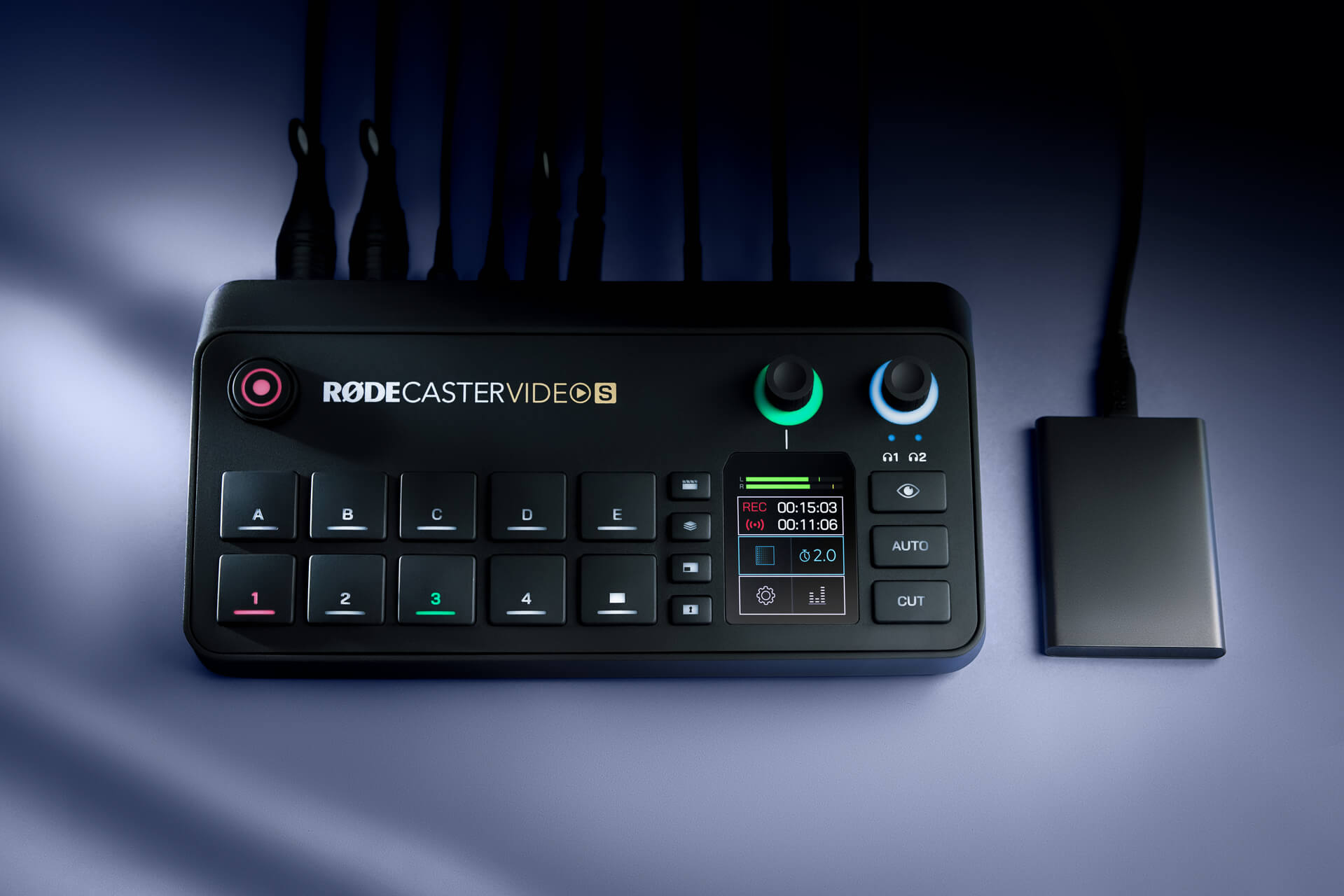
I have wanted to write about how Rode, mostly known for their microphones and audio mixers, has been making all the right moves in the video switcher market. Blackmagic Design, the maker of the ATEM line of video switchers, has all but abandoned the higher end of that market. Now maybe right after I publish this blog post, Blackmagic will introduce a new lower-end switcher that will compete with the Rodecaster Video, but we’ve been waiting a long time for any new announcements.
History
So briefly, here’s a bit of my history with ATEM switchers. In 2014, I heard about something called the ATEM Television Studio. At the University of Mary Washington, where I worked, we were doing lots of experimenting with live streaming and video production. In prepping for moving into a brand-new technology building, we were also speccing equipment to go into video recording spaces. The video equipment was from the company Blackmagic Design and it included switchers, cameras, recorders, video hubs, as well as miscellaneous accessories and converters.
Not quite a year after we moved into “the building that almost killed me”, I took a new job at the University of North Florida, where amongst my job duties was to enhance their video production space. I’ve created two more studios since then. All along the way I have been using Blackmagic Design equipment. The revolution happened at the onset of the COVID outbreak when we purchased what was known as the ATEM Mini. That was February 2020.
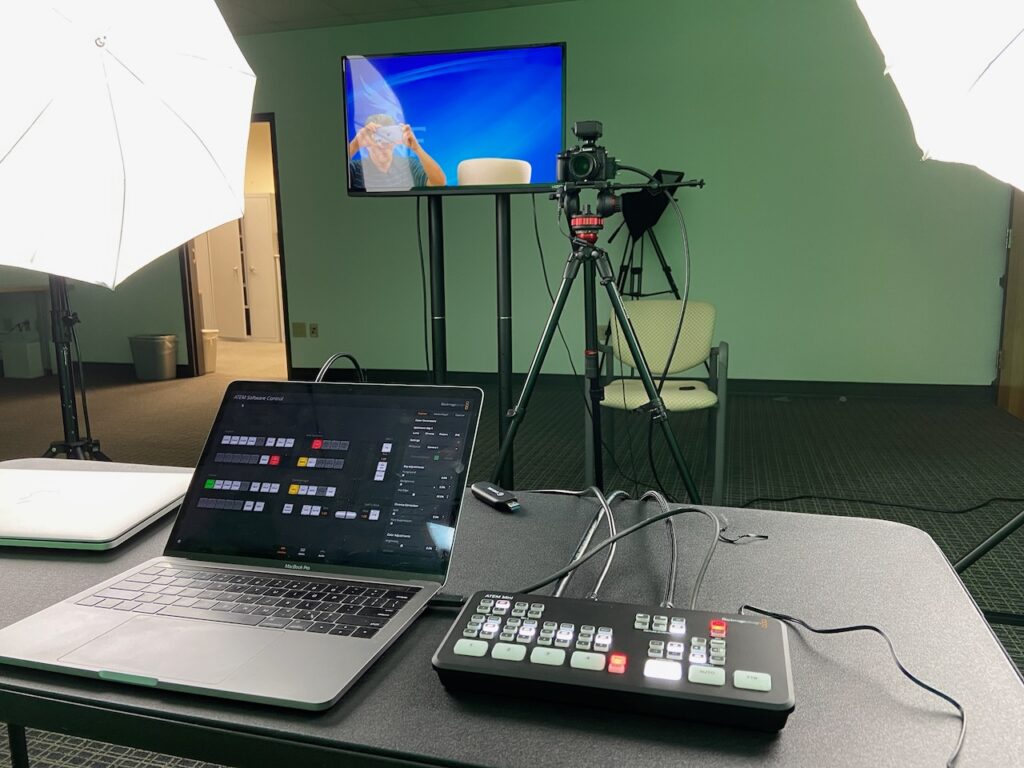
We’ve been using the ATEM switchers ever since at UNF and have expanded our studio capabilities thanks to the many Blackmagic upgrades and innovations.
Personal Use
I’ve recorded a few videos in my home studio this year. Not as many as I’d like, but I’m working on it. I haven’t done a “studio tour” yet. Which is a sign, or lack thereof, that as a “YouTuber”, I haven’t “arrived” yet. I’m only half-joking.
I’m lucky enough that the University of North Florida allows me to experiment with technology. I can take technology home and play with it on my own time, and of course returning it if it’s needed. As the many upgrades have happened, the ATEM Minis haven’t been in demand. We’ve expanded most of our productions, studio and live-streaming, to ATEM Mini Extremes, which are larger 8-input video switchers. The standard ATEM Minis do 4 video inputs.
So for a while now I’ve been using an ATEM Mini Pro ISO switcher to make recordings at home. We had long replaced it in the UNF Studio with an ATEM Mini Extreme ISO, so the Mini Pro ISO sat unused. The ISO model, by the way, is a video switcher that gives the capability of recording all of the isolated video inputs to an external SSD (solid-state hard drive).
I was essentially loaning the equipment out to myself. I also knew that at some point, ethically, I would need to purchase something for myself. There would also be an ethical reason for not recommending equipment to viewers that I have not spent my own money on.
Whatever gadgets I use, I want whatever I create with them, and about them, to be helpful. Helpful in ways that empower people to tell their stories. This long introduction’s purpose is to begin talking about one device that can help people do that. And why it has become central to what I want to create personally.
The Rodecaster Video S
The Rodecaster Video S is a versatile video switcher featuring three HDMI inputs, a USB-C UVC port, two XLR audio channels, and four NDI inputs with one NDI output. It includes a Scene Builder interface to create the equivalent of an ATEM “super source”-type layout. There is built-in auto-switching based on audio levels, chromakeying, and 1080p recording to an external ExFAT-formatted drive. Additional capabilities include Ethernet networking and streaming, Bitfocus Companion support, ISO project recording compatibility, headphone jacks, Rode wireless microphone integration, and selectable outputs on the HDMI, USB1, and NDI channels. You can choose from Program, Preview, and Multi-view sources, as well as clean camera/input feeds.
Rodecaster Video S vs. ATEM Mini Pro ISO
I’ve tested the Rodecaster Video S and confirmed its compatibility with various peripherals and workflows, successfully supporting an Insta360 Link 2 Pro webcam via USB-4, high-quality computer screen recording, and HDMI capture cards connected to the USB-4 port for an additional input. More on video capture in a bit. The device also facilitated iPad output through the USB1 port using a Guermok adapter and allowed NDI integration from a ZowieBox NDI encoder. Recording quality settings of 8Mbps are available for H264, and 27Mbps for HEVC (h265). However, H265 ISO at 60fps is not supported. All of the features of the ATEM Mini Pro ISO are essentially available on the Rodecaster Video, except one. The ATEM has built-in network file access to the recording drive so copying recorded files doesn’t require removing the drive from the switcher and plugging it into another computer. This is my top feature request for Rode.
So the ATEM Mini Pro ISO holds up well despite being introduced more than 6 years ago in July of 2020. However, the ATEM video switchers haven’t received significant updates beyond those for the Extreme ISO G2 release. To give you context, early on, Blackmagic released 3 ATEM Minis in less than a year.
There is no NDI support on any of the ATEMs, which is currently a popular standard of “network video”. The “Super Source” creation is only available on the Extreme models of the ATEMs and it is a bit complex to use. All but the ATEM Extreme ISO G2 lack XLR/combo audio options and headphone jacks. The ATEMs also lack a built-in media player that supports video playback. The Rodecaster Video switchers provide playback either from a built-in micro SD card (standard Rodecaster Video) or 20GB of internal storage (on the Rodecaster Video S and the Rodecaster Video Core).
As of September 2026, Rode has seemed to settle on pricing in the low $600 range (on B&H) despite Rode’s website retail pricing of $799 – ATEM Min Pro ISO pricing is $589 on Amazon, B&H, and BMD’s website.
ISO Recording and Editing
Some additional details about the ISO recording support on the Rodecaster Video. You have the option of having an EDL file, or an edit decision list, created along with the isolated video camera recordings. I use DaVinci Resolve as a fancy conversion program to open the timeline file and convert it to an FCPXML file for use in Final Cut Pro. Hopefully soon Apple will provide native support for those “otio” timeline files. This is the space where I wish all companies would support open standards. I think Rode supporting otio (OpenTimelineIO) is a way to be platform agnostic.
Now since the original Rodecaster Video has been released (October 2024), there have been many firmware updates to give the switcher more capabilities. They also released two new versions of the switcher – the Rodecaster Video S, the smaller version of the original, and the Rodecaster Video Core, a stripped-down version with no buttons for software-based control. A little over a year ago they added NDI video capabilities.
However, at the National Association of Broadcasters (NAB) trade show in April, Rode announced quietly that they were going to add 4K capabilities. At the time they didn’t elaborate. They said their internal chips could support 4K, but that resolution is very processor-intensive. People weren’t sure how they would pull that off.
Well, as of September 2026, Rode released an update to do 4K Capture of all the ISOs. That makes more sense than it being an upgrade to 4K switching, as the current processor wouldn’t be able to keep up. The cost of 4K switchers ain’t cheap. They start at about $2,000 and Blackmagic Design’s cheapest 4K switcher starts at over $3,000.
I’m currently testing the 4K capture feature so I’ll talk about that and more about how I’m using it in upcoming posts.
Leave a Reply