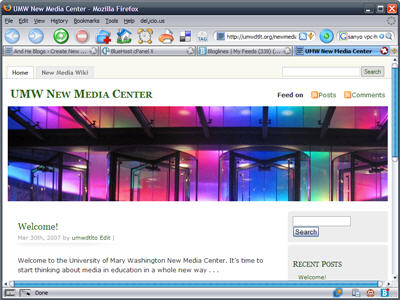
With a push from Jim Groom and a confirmation that the title of this post has the right goofiness, I wanted to share some progress I’m making on the tool integration front. The idea was to have a space, or maybe the term is a platform, to launch an information repository for using “new media” at the University of Mary Washington. Since relocating to duPont 310 here at UMW, we have had accelerated discussions about tools, integration, RSS, screen-scraping, semantic web, etc. I’m more of a tools guy who keeps his ears and eyes open for what is needed in academia. “The Bluehost Experiment” has provided us with some great tools to play (my specialty) with, which include Drupal and WordPress. The recipes, however, are up to us, and when we think the drink is just right, we ask others in our group (DTLT specifically) to taste and see what’s right and where we need improvement. The fear is always that the concoction doesn’t taste the same to others.
Let me get to the specifics. I have taken what almost literally are puzzle pieces and tried to get them to fit together, and I’m somewhat surprised at what I’ve come up with. I’m a BIG fan of WordPress. Almost immediately it was clear that this tool could showcase all the different types of media that I work with – images, audio, video, and Flash. However, a blog is, most of the time, a one-dimensional presentation of information. By that I mean that the posting of information is linear, and it doesn’t lend itself to exploring topics in a non-linear fashion. The most current information/topic is easily accessible, but previously posted topics are somewhat buried (though still available through search). So you may think, well, Drupal is your answer. It’s a content management system. It SHOULD be your answer.
Drupal is powerful, there is no doubt. However, getting it to do what WordPress can do, in terms of media presentation, is a frustration. While Drupal would be ideal in laying out the information in a structured manner, I have concluded that in its present versions (both 4.7.x and 5.x), and with current modules it falls short of the media presentation platform that I envision. The tool that is the surprise is the wiki, specifically the MediaWiki software, which is not a point and click install with Bluehost. Though installing it is one of those procedures that gets easier every time. My great discovery over the last several months has been its extensibility, and for me, one of the “holy grails” was the discovery of the YouTube Extension. The other holy grail is embedding of FLV format videos (watch this space for a future post).
The other surprise about MediaWiki is the user management. While not as granular as Drupal, it does work well enough to give MediaWiki the ability to manage user editing permissions, and still keep the openness of the wiki format. I guess it’s not really a surprise since Wikipedia is a MediaWiki and there are thousands (millions?) of users. Drupal may one day be the glue (Glu?) that holds it all together, but for now it just gets in the way of where I want to go with media presentation.
So what does all this look like? Well it looks like this – The UMW New Media Center. Click on the New Media Wiki tab at the top of the UMWNMC page and see how the wiki is tightly integrated into the design. The early reviews (from my colleagues in duPont 310) on this refreshing beverage have been positive. It is done with a theme/skin called MistyLook. The look is easily customizable by changing the header image, and tweaking the CSS is always an option as well. The WordPress theme is here, and the MediaWiki skin is here.
I have to give a major shout out to Trevor Wennblom for his literally providing THE key piece of the puzzle. Before March 30, 2007, the version of the theme that was available only supported MediaWiki version 1.9.3. A “can’t hurt to ask” email to him looking for assistance in getting a version of the skin that supported 1.6.8, was answered within a couple of hours. “Gotcha covered, Andrew”, and the version I was looking for was available for download.
As an epilogue to this post, I wanted to say that many times I felt that spending so much time on the design and what the site should look like was unwise. However, it appears that it might have been the key to making this concept work. MistyLook may be the “K2” of the Wiki/Blog era that we are moving towards.


44 Responses
Words of wisdom, Lloyd, words…of…wisdom! I’ll be playing misty myself very soon -I love K2 but the Wiki/Blog era of integration is calling!
I know a lunatic who’s teaching an introduction to new media studies this summer. If you can stand the gibbering and strange looks, he might be a worthy partner for some development and envelope-pushing. I know *he’d* enjoy it.
MistyLook is very compelling. Hard to believe I’m looking at MediaWiki. The web just extruded another service. Very deeply cool, Andrew. 🙂 Wow.
I’m ready to push the envelope with said lunatic!
Andy,
This is so cool. I also can’t believe I’m looking at a MediaWiki install. It really feels seemles. . .
Awesome.
Martha
*seamless* sigh.
Andy, nice work. Can you clarify something for me? What are the actual pieces that are integrated here? Is it the common look and feel across the two apps? Or is it also the account systems? More? Cheers, Scott Leslie
Looks cool enough, but are the users/identities shared across the systems or is it just an integrated look and feel via skinning?
Hello,
The theming/tabs are very nice, and it’s a great implementation, but one piece of the post needs additional comment:
“I have concluded that in its present versions (both 4.7.x and 5.x), and with current modules it falls short of the media presentation platform that I envision.”
Embedding media in Drupal is simple — it can be done by allowing full html, and there are several modules that allow you to specify sites from which video can be embedded — in 5.x, the cck videofield, and in 4.7 (and possibly 5.x) there is the Object Embed Filter. Additionally, you can allow a user access to full html and embedding video is a cut and paste exercise. Additionally, there is even a module for 5.x that uses ffmpeg to convert different file format to a flash format so an organization can create its own private YouTube-like site.
Combine this with a recently released module that synchs users between Drupal and Mediawiki, and all that’s left is the theme — and that misty theme is very nice.
Cheers,
Bill
For Chris and Scott – it is just the common look and fell that is integrated. This is just the first stage. Soon after finishing this “theme integration” my colleagues got a “hack” working to pull content out of MediaWiki and into the WordPress (way to go Patrick and Jim). Integration of users is seen as a logical next step, but we’re not there yet. I think we’ll at least investigate something like OpenID (and maybe some sort of LDAP stuff), but we’d love other suggestions. This is only a start.
Wow, what a stunning design and connection, there Andy. One hardly knows that they are going back and forth between blog/wiki or 2 different platforms.
Time to nominate this for the “Best Integration of Blogs and Wikis in A Leading Role” at some un-invented edu web academy awards.
So really this was enabled since a theme was available for both WP and MW?? How many cross-dressing themes are there?
And regarding the user accounts “management”– I’m interested in knowing how that is done. Are you using different groups within MediaWiki? How are they assigned as accounts get created (or are you creating accounts directly)??
Mucho kudos! Look forward to meeting you at UMW next month.
PS- and capped by a wink for the blog post title! Where is Dave Garver?
Andy, thanks for the details. Once again, great work!
Cheers, Scott
Thanks Andy. I was dreaming that we could do something like this for my library, but don’t have the tech skills to do it. Nice to know someone has done it and I can look over your shoulder.
I’m surprised about my response to the MediaWiki with that skin, however – my mind keeps telling me “it’s not a wiki…it’s a blog, a blog, a blog”. I’ve come to expect a blog to be more personal, conversational and unpolished than a wiki. I wonder whether a solution would be to make the page width fluid and default to wider, so that it has more of a “page” feel and less of a column feel ?
I’m hoping that eventually we won’t obsess about how a page was created (is it a wiki? is it a blog?) and will focus just on the content..so maybe having them identical is spot on?
hey can you specify some templates to be attached with media wiki
are templates found
can we find templates for mediawiki
http://meta.wikimedia.org/wiki/Gallery_of_user_styles
This here comment has nothing to do with the mediawiki discussion. I want to leave a comment about the plot of the movie itself, I think that it is one of the most lousiest movies ever made. Eastwood’s character, Dave Garver is a despicable, male-chauvinist pig, that only loves a woman for her body and nothing more. If he didn’t want anything to do with Evelyn, than why did he bother leading her on in the first place? C’mon now, this isn’t all her fault, you know, she really liked him, and was (only normally) looking for him to rescind his love for her, which he, in the beginning, actually did by going all the way with her, in her apartment. It also had at the end of the film, a scene of violence that really, really exploits abuse toward women. Garver pummels her in the face, then killing her. I personally, wouldn’t recommend it to a Pit Bull to watch. It most certainly was Eastwood at his worst acting. And as far as the later Fatal Attraction is concerned, that too, should have never ever gotten the rave reviews that it did. It didn’t deserve it. Of course, it was no better. Only Michael Douglas was the antichrist instead of Clint Eastwood. Movies such as these cheapen (demean) women that are a little less fortunate in winning the man of their dreams, and that just ain’t the cast at all. I would have loved to see both films with an opposing plot, with both guys dumping their little dumb, slut, bimbo,and unfaithful trophy wife/girlfriend for the latter woman. The poor things were lonely little souls that only really needed and wanted a caring and trusting friend. And taking them over their stale, unhappy present relationships would have been the right thing to do. For both of these women truly loved their conquests and nothing more.
Quick question – when I unpack the file at “…Mediawiki skin here.”, I’m asked what the extension of the file should be.
I assumed .php since it’s a skin, but that gave me a error message and what appears to be jibberish in the file along side what appears to be css code. So I unpacked it again, setting the extension as .css. Same error message and jibberish. Of course, if it’s not a .php, it doesn’t show up as a skin choice.
I presume I’m making a mistake based on newbieness to this or just being tired at the end of long day.
Any suggestions?
Tony, I’m not sure what program you’re using to unpack the file, but it’s not just a single file. The .tgz extension is just another type of “archive” like “zip” or “jar” or “tar” or “tar.gz” which can contain many files. This archive does indeed have a mistylook.php file but there is also a mistylook directory (folder)that contains css and image files. Also not sure what platform you’re using, but on the PC I use a program called ZipGenius to view and extract non-“zip” files. My web host also has a program built into the online file manager that can extract the files properly. Hope this helps.
Has anyone else run into a problem using Google Maps with the MistyLook skin in MediaWiki? The sections of the map/satellite images are separated by white lines, and lines show up around all marker too.
Is there a simple way to tweek the CSS to fix this problem?